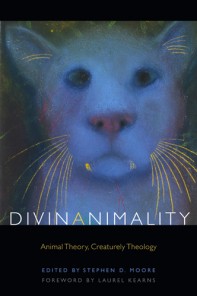
Book/Chapter Announcement: Divinanimality: Animal Theory, Creaturely Theology

Divinanimality Cover

The book has been out for a few months now, but I’ve yet to make an announcement here. Divinanimality: Animal Theory, Creaturely Theology came out of Drew University’s Transdisciplinary Theology Conference. The handsome book was edited by Stephen Moore (of Drew University) and features a range of essays. Personal highlights for me were the chapters written by Denise Kimber Buell, Beatrice Marovich, and Stephen Moore. I am honored to have a chapter in the volume: “The Logos of God and the End of Humanity: Giorgio Agamben and the Gospel of John on Animality as Light and Life.”  Working from the prologue to John’s gospel, my chapter argues for an understanding of the incarnation that undermines anthropological exceptionalism rather than supporting it. In other words, I am working to refute the notion—heard commonly enough in Christian circles—that human beings are the most important creatures on earth because God became human. I engage briefly with Athanasius and Gregory of Nazianzus along the way. I also venture a more synthetic reading of Derrida and Agamben on “the animal question” than is normal in critical animal theory circles.

One of the benefits of posting this announcement a bit late is that I can link to a blog post by Adam Roberts on my essay. His summary is accurate and his critical questions are on target, so far as I am concerned. I have a response posted in the comments. He has a few other posts on the volume, which can be found here.

The Divinanimality of the Logos and the Curse of Human Uniqueness

I’ve been working today, editing my essay for the Divinanimality volume, coming out later this year through Fordham University Press. Here is a favorite paragraph from the essay—one of the most explicitly theological paragraphs I’ve written in years. In context, I’m making an argument for rethinking the significance of the Incarnation for thinking about the human-animal distinction:

On this understanding, the Logos of God is no longer the Master Signifier, the keystone that anchors the logos of self-reflective human thought and speech in a stable economy of meaning. Instead, relative to the logos of humanity, the Logos of God is negatively transcendent. God’s Logos is the charged silence over which humanity finds itself interminably babbling. The logos of humanity can find no entryway into the Logos of God; it tries to speak its way over a communicative abyss rather than being immersed in the silence of divinanimality. The unsettling eyes of animals—whose gazes have so little regard for human discourse—are unsettling not because they lack meaning but because they convey an excess of meaning that cannot be borne in language; they are icons of the mystery of the zōē of God. The living silence of the divinanimal Logos offers (or threatens) to swallow whole the logos of humanity—and no one can guess what kind of new zōē might emerge from this end

The paragraph and the paper in which it lives grew out of this post from a few years ago (see mom, blogging is good for something!). One of the broader contributions that I hope to make through the essay is the argument that despite their many differenced and disagreements, Derrida’s and Agamben’s texts on animality and politics are not only mutually illuminating, but have a kind of convergence. So, it’s an effort to read The Open and Homo Sacer alongside The Animal that Therefore I am and The Beast and the Sovereign—all in the context of John’s prologue.

Roots in the Air: Honesty, Poetry, and Abstraction

“Man is an upside-down tree, the roots of which are in the air.”

 – Shem Tov ibn Shem Tov

In context, Shem Tov—a Spanish Kabbalist quoted in Agamben’s The Kingdom and the Glory—is speaking about how humanity feeds off of spiritual nourishment, rather than the material world. The image, however, has stuck with me for another reason, and fed my thoughts over the last week or so with regard to the integral role of abstraction within our thought and language.

Personally, I’m recognizing how frequently I take recourse to abstraction in my writing and in my teaching when I’m unsure of the point that I’m trying to make, or trying to dance around some sensitive issue. It’s always easier to treat a topic from 10,000 feet above it, rather than mucking through the particulars. It is a symptom of my laziness, an attempt to avoid the hard work of research or careful thinking that would allow me to write or speak more exactly. As such, I’m trying to shorten my own leash on abstractions.

More generally, I’ve become aware of how much power there is in abstract language to mask and distract. Abstraction allows someone to speak when there is really nothing to say, or to speak in a way that obscures what is really taking place.  Not only is abstract speech very often the language of politics (especially campaign politics), it is frequently the language of religion, and most unfortunately, the language of prayer. Abstraction is empty talk, the raw material of ideology; but it is nonetheless effective for that. We have our roots in the air, and we feed on abstractions.

In contrast, concrete-ness is the blood of poetry; intimacy with poetry provides an education in avoiding abstraction. I’m sure that this statement will come back to bite me, but I can’t think of any straightforwardly ideological poetry.

Of course, politics, religion, and prayer are hardly dispensable or peripheral human activities, and I’ll be the last to try to put a stop to any of them. But without question, politics, religion, and prayer are the most honest, and do the most good, when they forego winged words and endlessly maleable concepts and speak instead with earthy imagery, verbs that move, and visible nouns.