where do we stand? :: Bonhoeffer and Lewis on ethical ground

C.S. Lewis makes several impassioned pleas for the universality of moral instinct in his writings. I’m most familiar with his appeal to the sense of “fairness” in an argument for God’s existence in Mere Christianity, along with his defence of what he calls the “Tao” in The Abolition of Man. At any rate, in both locations, Lewis is appealing to something like conscience or intuition as the ground of ethics. Ethics are built-in. Right and wrong find their foundation in some innate sense within us. That sense is God’s gift, and is ultimately grounded in God’s own moral character.

Of course, acknowledging the lingering wastes of sin in humanity, Lewis argues that our consciences, as well as our inclination to listen to them, are “bent.” We are not whole and healthy, but twisted and shadowy representations of what we were meant to be.

Working on Bonhoeffer’s moral epistemology, it struck me how different the picture that he describes is. For Bonhoeffer, conscience is only the voice of self-defence. Conscience is the tool by which we usurp God’s judgment, and employ it against ourselves and others. With our consciences–our personal knowledge of good and evil (Genesis 3)–we alternately declare ourselves righteous and then cast ourselves on to the dung pile. Either way, this is an attempt to shield ourselves from God’s voice rather than God’s voice itself. The natural knowledge of good and evil, is nothing less than captivity to death in Bonhoeffer’s estimation. Continue reading “where do we stand? :: Bonhoeffer and Lewis on ethical ground”
creation is bigger than nature

Reading Jurgen Moltmann’s, God in Creation I came across another way (probably a better way) of saying what I was trying to get at the other day. Once we have a sense of our independence from the world around us, we have a proclivity to wield that independence over our surroundings in relationships of control and domination.

Creation is bigger than nature.

By “nature” we can signify all that is subject to scientific study and, on some level, to human control. The concept of nature is strongly tied to “natural law” so that nature is everything that follows predictable patterns of behavior. Over the last few century’s “nature” has expanded to include not only physical laws like gravity, but (viaDarwin and friends) biological development and behavior. The development of psychology aims to incorporate the human mind into nature as well–the “experimental” and “philosophical” branches attempting to account for the neurological (objective) and existential (subjective) aspects of the mind, respectively. Continue reading “creation is bigger than nature”

ecology and consumption :: the “nimby” effect

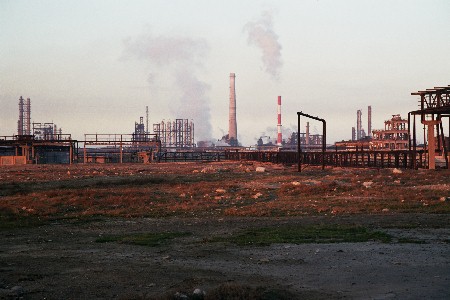
Here is a list of ten places you will not see on the cover of any travel magazine for the next few…hundred years. For the second year running, the Blacksmith Institute has released a list of the most polluted places on the planet. Needless to say, there was an unfortunate amount of competition for the honor.

Factory in Azerbaijan

What is remarkable (but not necessarily surprising) is the concentration of sites on the map. North America (North of Mexico), Western Europe (West of Belarus), and Australia are scot free. None of the top ten, not even the top thirty most polluted sites are to be found in our backyards. What does this mean? Should we “developed folk” congratulate ourselves on the success of our environmental regulations and efforts at conservation? We’ve realized our errors and are cleaning up our messes. We are taking good care of the planet. Being stewards of what we’re given. Those backwards folks in the third world have yet to get on the ecological bandwagon.

I would not be too hasty with the laud. It rests on an answer (“Not In My Back Yard!”) too facile to function for long. Continue reading “ecology and consumption :: the “nimby” effect”

a voice of hope :: reduced to silence

Pius Ncube, archbishop of Zimbabwe and one of few outspoken advocates on behalf of the Zimbabwean people against their tyrannical mismanagement, has resigned. The reality underlying his reasons is unclear. The minimum information inferrable would seem to imply both that Ncube was involved in some form of sexual misconduct, and that the government was more than passively involved in the matter. At the end of the day, the unfortunate result is that one of the voices most able to counter the lies and trickery coming out of Harare will now have to do so from a much smaller platform.

nature and civilization :: of dirt and dangerous divisions

Scraped together out of dirt, humanity is creation rearranged. Our atoms are interchangable with those of birds, bees, monkeys and mollusks. Theologically, no less than biologically or chemically, humanity is continuous with creation. Whatever is going on in the show here, humanity is a part of the scenery.

Some complexity is introduced when God leans down to breathe into the muddled mud-ling he’s put together. Dirt that shows something about God, “images” Him. Humanity has a unique role on the planet we are a part of.

Somewhere along the line, we became civilized. This is mostly measured by the fact that we are no longer dependent on nature in our day to day lives. Signs of civilization include the light bulbs that enable us to read late into the night (a much more convenient form of light than fire…), and the fact that we can live in rediculously uninhabitable places like Antarctica or Alberta. If you are a human being reading this, give your self a pat on the back–you are civilized!

As wealthy Westerners, it is tempting to interpret this functional impervious-ness from “nature” as independence, as a mark of real distinction between us and the rest of the planet’s inhabitants. I will be the last one to deride technology and all the benefits of human creativity. That said, independence from nature is a destructive myth, dangerous both ecologically and theologically. Our “civilization” fuels this myth and enables a noxious self-misunderstanding. Continue reading “nature and civilization :: of dirt and dangerous divisions”

daniel’s four beasts :: four Kingdoms

I’ve just posted a paper in the “Essays and Papers” page that I wrote over the summer. For those of you with a Biblical bent, the paper enters the 2,300 year old debate over the imagery the author of the book of Daniel employs to speak about the kingdoms of the earth. The images have been trotted out in various apocalyptic schemes for thousands of years, the latest renditions being Hal Lindsey’s Late Great Planet Earth, and the infamous Left Behind series by Jenkins and LaHaye. The books cryptic imagery has been mis-read in some fairly fantastic ways.

The paper makes the argument that the first three beasts/kingdoms should be read historically, while the fourth should be read eschatologically. The book of Daniel, rather than being a time-table for the last days, is a warning to the powers of the earth about their responsibility to their people. When the world’s kingdoms forget the humanity of those subject to thier control, they turn into bloodthirsty beasts liable to God’s judgement. Undercutting our eschatological self-righteousness, I argue that Western nations like the United States can be identified as the fourth beast just as easily as Ancient Greece, Rome, the USSR, or any of the other “usual suspects.” The “Son of Man” figure represents the restoration of God’s image in humanity in the form of a fifth kingdom which displaces the four-fold beastly reign of terror.

This paper comes out of a course taught by Regent’s Iain Provan, and he deserves credit for most of the good ideas in the paper (you be the judge) but he should be exonerated from its faults.

summer update

Stanton Peak
Hello all. My noted absence in the electronic realm lately is due to my much needed presence off in the Sierra Nevada. I’ve just finished leading two separate trips (with Carolyn) for Sierra Treks.

The first was an eight day trip for alumni of an off-campus program in Oregon – The Oregon Extension. The OE, as it is called, is home to a handful of wonderfully eccentric professors, one of whom was on the trip with us to lead us in bible study and contemplative practices. John Linton is a wonderful fellow to get into a long conversation with. He’s deeply interested in questions of violence, and especially religious violence. Continue reading “summer update”

personal belief and corporate confession :: creeds and community (part IV)

The last entry thinking about the creeds focused on the relationship between the creeds and scripture. As normative confession, the creeds guide the boundaries of our interpretation of scripture in order to enable us to read scripture well. The creeds stand as a history lesson about God’s people reading God’s word; they are our opportunity to hear and understand the thought of those Christians who down through the generations have passed on the gospel and put the scripture in our hands. We disregard their advice at our own hazard. We cannot even touch scripture until someone gives it to us – and that event (taking the book into our hands) links us to a long chain that reaches back to the roots of our tradition. Any loss of memory constitutes a crisis of identity, but especially an intentional ignorance with regard to tradition.

In this entry however, I’d like to dig into questions about the normative influence of the creeds within the church today – look at how we relate to these ancient documents, and how we are to look at them. How do creeds function within our communities? What do communities that move away from creeds replace them with? Continue reading “personal belief and corporate confession :: creeds and community (part IV)”

summer road trip :: stage two

Carolyn and I just returned from a week with my family at Lake Powell – that ecological abomination in the desert. It was a real treat to get to see everyone for a few days – aunts, uncles, friends, brothers, sisters, and a grandma – coming from all over the country. Like most Meyer vacations, we left more sore, tired, and bruised than we arrived. The highlight of the Lake Powell trip is the “dawn patrol.” This means getting up at 5:30 to throw yourself out of the ski boat while the water is still glassy smooth. Here are a few pictures for you. Continue reading “summer road trip :: stage two”

zimbabwe’s archbishop speaks out

The following is the text of a BBC article on Zimababwe’s outspoken Roman Catholic archbishop. Ncube (pronounced “N-ts-oo-bay”) is standing against a unjust government in the name of the church and the people of the nation. I’ve mentioned him before.

Zimbabwe crisis ‘threatens lives’

Archbishop Ncube says Zimbabweans are desperate

Archbishop comments
Roman Catholic Archbishop of Bulawayo Pius Ncube says the political and economic situation in Zimbabwe has reached “life-threatening proportions”.
He accused President Robert Mugabe’s government of not taking responsibility for the deepening crisis.

He says there is almost no fuel in the country, and every day, people are reduced to hunting for a loaf of bread.

The archbishop said it had reached a point where regional political intervention was now needed.

Talks between Zimbabwe’s ruling party and the opposition resumed in South Africa this week, with President Thabo Mbeki responsible for mediating.

‘Megalomaniac’

But Archbishop Ncube said he doubted that President Mugabe would step down as Zimbabwe’s leader, in return for an amnesty deal.

“Mugabe is a man who is a megalomaniac. He loves power, he lives for power. Even his own party are pleading with him – ‘Please stand down, you’ve done enough good’.

“According to Zanu-PF he’s done a lot of good, according to me, he’s done a lot of evil.”

Archbishop Ncube was speaking in Johannesburg as the Solidarity Peace Trust, a church-based non-governmental organisation, launched a new report on the crisis in Zimbabwe.

In its report, the Solidarity Peace Trust, says there has been increasing state repression against dissenting voices since March when many members of the opposition were arrested and beaten.

It also says the governing party in Zimbabwe, Zanu-PF, has lost much of its political legitimacy.

Mr Mugabe blames the worsening economic crisis on a Western plot to remove him from power.