Eschatology and Ecology

The problematic relationship between Christian theology and ecology is often set up as a question of eschatology. The problem of whether Christians can really value created being is made synonymous with the question of whether the planet is destined for fire when we all “go to heaven” or whether the earth, too, will be redeemed. The ecological program of theological re-education becomes the task of convincing people that all of creation has a future with God (and usually involves copious, and atypically literal, reference to Revelation 21). While this eschatological perspective on creation is clearly important, more and more I think that it is a red herring rather than the crux of the issue.

A metaphor is helpful here. If we think of creation as the stage on which salvation history takes place, then the real drama is human history, and “nature” is made into a static entity which serves as the backdrop. The stage is manipulable according to the needs of the story and the movements of the characters. In this context the questions in the paragraph above come naturally. Will the stage be preserved? Does the stage get to come along when the actors who have gone off-stage are finally invited into the fullness of fellowship with God? In this vision, history happens to, and with, and through human beings while creation merely tags along as the proper habitat for bodily resurrection at the great day of the Lord.

But the real issue ecologically is not what “will happen” (or better put theologically, the shape of the “not yet” for creation that corresponds to the “already” of Jesus Christ), but the human relationship to creation in the present. We can think about creation as a resource to be instrumentalized even while we hope for its eventual replenishing. Our willingness to undermine the integrity of all the planet’s ecosystems and consume the ground out from underneath our own feet betrays a flippant conception of the world in the present.

Here are a few questions rumbling under the surface:

In what way do rocks, trees, birds, fields, and rivers relate to God on their own, without human intrusion?

Should we (can we?!) try to think about this relationship theologically in order to protect it?

How can we think theologically about positive human interaction with creation—inevitably including eating, building, and being creative—without assuming that creation is a resource provided for our purposes? 

How can we comprehend the magnitude of God’s acts in Jesus Christ, without arrogantly assuming that humanity mediates creation’s significance to God? 

free market as religion :: economics as theology

“Our present economic system should also be understood as our religion, because it has come to fulfill a religious function for us. The discipline of economics is less a science than the theology of that religion, and its god, the Market, has become a vicious circle of ever-increasing production and consumption by pretending to offer a secular salvation. The collapse of communism makes it more apparent that the Market is becoming the first truly world religion, binding all corners of the globe into a worldview and set of values whose religious role we overlook only because we insist on seeing them as ‘secular.’” (15)

It is important to pay attention to the conceptual employment of both “secularity” and “religion.” Both concepts have shifted their content so that they demarcate autonomous spheres of ethical thinking. “Religion” is an abstract term that enables the speaker to lump incredibly diverse worldviews together in a single term, and generally, to contrast them to something else. “Religion” is the corral which contains a certain motley collection of worldviews in order to open space for the “secular.” The “secular” on the other hand is the “real” world in which thought is reduced to basic material and utilitarian terms, without the distraction of (private) values, beliefs, or metaphysical constraints. Past traditions (with their encumbering and superstitious restrictions) and any sense of the intrinsic importance of wild beauty or freedom are “external” considerations, things for other people to worry about in private—after all we live in the real world, the public sphere. 

“Although it may offend our vanity, it is somewhat ludicrous to think of conventional religious institutions as we know them today serving a significant role in solving the environmental crisis. Their more immediate problem is whether they, like the rain forests we anxiously monitor, will survive in any recognizable form the onslaught of this new religion.” (15) 

In exchange for a deeply grounded identity and a place in the ecological whole of the planet, we receive the consumer frills of a culture burning all the world’s candles at both ends. This “plenty” for which we endlessly labor is, supposedly, heaven. Or at least a third-rate knock off. Because perhaps, in the end, this is the heaven we’ve been imagining since Dante—divorced from the world that we know, from rocks, trees, lions and lambs. The (unreachable, but always “close”) heaven of the Market is that insipid climate-controlled cloud where nothing interesting ever happens because we’ve finally isolated ourselves from all of nature’s unpredictability (btw, there’s harp music for $2, if that’s your thing). 

“Market capitalism began as, and may still be understood as, a form of salvation religion: dissatisfied with the world as it is and seeking to inject a new promise into it, motivated (and justifying itself) by faith in the grace of profit and concerned to perpetuate that grace, with a missionary zeal to expand and reorder (rationalize) the economic system [where its ‘good news’ has not yet reached].” (19)

The myth of “secularity” is that a society can exist without some fundamentally orienting value distinctions (even a plurality), without some basic ordering of perception, and interaction with, the world. As it turns out, it cannot—the basic order appears implicitly and unacknowledged rather than consciously. When the free market is understood as the source of these fundamental value distinctions, even though it is supposedly “secular,” one recognizes its religious function in our lives. One corollary of this is that the “Separation of Church and State” is revealed to be a myth—without even entering into a debate about evolution or prayer in schools. Our “State” has a deeply vested interest in the national Establishment faith, the progress of the market. 

“Until the last few centuries there has been little genuine distinction between church and state, between sacred authority and secular power, and that cozy relationship continues today: far from maintaining an effective regulatory or even neutral position, the U.S. government has become the most powerful proponent of the religion of market capitalism as the way to live, and indeed it may have little choice insofar as it is now a pimp dependent upon skimming the cream of market profits.” (21) 

The most pressing theological tasks of the present include “publicly” exposing the (invisibly) idolatrous invasions of the market into the life and well-being of the planet; and narrating a tradition with a strong sense of identity rooted in a deep and complex history—a community with open boundaries and a promiscuous invitation.


__________________

All quotes from:

Loy, David. “The Religion of the Market.” In Visions of a New Earth: Religious Perspectives on Population, Consumption, and Ecology, 15-28 Ed. Harold Coward and Daniel Maguire. Albany, NY: State University of New York Press, 2000.

looking to write a book? :: orthodox eco-theology

Whenever theology and ecology come to the same table for a chat, inevitably, Eastern Orthodoxy comes up as a church that has “gotten it right.” Someone will say that they’ve never divorced flesh and spirit the way we have in the West; laud the Eastern understanding of the sacramentality of all creation; talk about the Theophany and the blessing of all waters; or connect the dots between the Incarnation, icons and the sanctity of all matter. His All Holiness Ecumenical Patriarch Bartholomew is known as the “green” Patriarch for his work advocating for ecological responsibility from a deeply Christian standpoint. 

So where is the book on ecological theology from an Eastern perspective? 

No one has written it. 

There are bits and pieces here and there—articles, chapters, and allusions—but when you go looking for something more, there is, well, not much more. I’m calling the bluff: Given the deep resources within the Orthodox tradition for ecological thinking, I’d like to see someone synthesize all this iconography and liturgy into something more explicit, more direct. Heck, in my library, there are already eight shelves full of eco-conscious Protestants and Catholics selling books on the subject!  

And if you’re willing to take me up on it, would you mind writing this before my term paper is due?

your mouth and creation’s praise :: Leontius of Cyprus

Some wisdom from the 7th century: 

Through heaven and earth and sea, through wood and stone, through relics and Church buildings and the Cross, through angels and people, through all creation visible and invisible, I offer veneration and honor to the Creator and Master and Maker of all things, and to him alone. For the creation does not venerate the Maker directly and by itself, but it is through me that the heavens declare the glory of God, through me the moon worships God, through me the stars glorify him, through me the water and showers of rain, the dew and all creation, venerate God and give him glory. 

Doctrine, Ecology, and Justice (part 3 of 3)

[Back to part 2]

In this vein, we can now move from Christology toward ecclesiology in order to think about the sort of community that inculcates the vision of dominion-as-service. The church, marked by the anointing of the Holy Spirit through its baptism, is the point of continuity between the old creation and the creation of a new heavens and a new earth.[5] The “body of Christ” is the hint of the new in the midst of the old, the kernel of wheat, which having fallen to the ground, may soon sprout with a manifold harvest. As such, the ecclesial community is where the dominion of God breaks in on the corrupted exercise of an idolatrous and demonic dominion. The church’s calling to follow the Lord entails a radical reorientation of the old creation toward the new through repentance and obedience. The community gathered in Jesus Christ interprets the present world in a new light, the light of the coming dominion of God; in that light, the church community discerns the virtues that mark the harmonious life of that dominion and inculcates them in its members in the present. The individual people of the church find their own particular role within the mission of the whole body while that common mission joins disparate lives together by instilling the virtues that are necessary for a common enterprise.

When an ecological understanding of the dominion of God and the life of the church community are brought together, two things happen: First, the anthropologically unrealistic and ecologically destructive erosion of communities under the auspices of market capitalism is arrested and countered. In order to sustain perpetual growth (the ideological bottom line of market capitalism), the units of ownership and identity must be continually broken down to smaller and more homogenous levels. The limit of this trajectory is the society in which common ownership, or sharing, is reduced to a minimum. A few examples: Every American family seems to have its own lawnmower, but how often are all of them in use at once? Cell phones undoubtedly bring a gain in personal convenience, but the phone companies are the greater beneficiaries when a family no longer shares a single phone, but every member carries his or her own (not to mention old multi-family “party-lines”). In the past, music was primarily shared in public performance (whether in an opera hall or in a tavern), but has become increasingly commodified in formats where individuals purchase songs that are subsequently “illegal” to share. In terms of identity, the free market desires that society in which every individual (and persons are emphatically conceptualized as individuals) actively constructs and expresses his or her own identity by means of purchases and fashionably-up-to-date status markers. Identity is less and less expressed in stable social terms (family, religion, heritage) and is increasingly expressed by material possessions and interchangeable voluntary associations. To express identity in terms of ecological relationships would be incomprehensible—despite the undeniable fact that our lives are inseparable from the ecosystems we inhabit (even if only remotely). Still, “I live in a wetland with fox and ducks and reeds,” is not a culturally viable answer to the question “Who are you?”

In contrast, in a robust church community identity is held in common, the gift of Christ’s name and the transformative work of the Spirit. The fellowship of the church is an ideal venue for shared ownership and mutual assistance. Furthermore, in a church community which has not reconciled itself to the cultural influence of capitalism, (as a non-binding voluntary association of individuals looking for some product—“religion”—to consume), a counter-vision of human society and humanity’s place in the planetary ecosystem can take root. A community that expects to see the old creation transformed into the new creation in the dominion of God becomes conscious of the foolishness of a sense of material entitlement, of self-centered human exceptionalism, and of individualist constructions of identity. All we living creatures, after all, come from the same dirt!

Second, as a geographically and temporally extended community with some integrity the church is a venue for the inculcation of virtue. The work of Alasdair MacIntyre has demonstrated that virtues can only be generated within communities where action, purpose, and identity are mutually intelligible on the basis of shared interpretations of experience.[6] The church is just such a community where virtues may arise and find mutual reinforcement in the shared lives of the members. In terms of ecological ethics, many people have recognized that a virtue-based approach is crucial.[7] Rights and obligations are helpful, but only insofar as they delineate boundaries that should not be crossed; they are legislative rather than formative. Thus, while Nash’s preference for rights language leads him toward helpful suggestions for legal action (a necessary step to be sure), the fundamental problems are more deeply rooted than a re-conception of ecological “rights and responsibilities” can address.[8] The scope of the ecological crisis requires more than rearranging the boundaries and limits, a little tightening of our belts. The frequency with which the word “conversion” appears—even in adamantly secular venues—testifies that a deeper re-orientation is needed. Not only to we need to back off from the line marking just how much degradation our planet can sustain before it collapses, but we need to begin living in such a way that we contribute to the health of the planet as a whole. Limits and boundaries have pragmatic value, but must be seen as secondary to the virtues that sustain a moral orientation and guide thought and action at a deeper level. Ethics is a matter of identity, and only subsequently a matter of actions.[9]

For that reason, the scope of the church’s vision—stretching from the gift of creation to the hope of new heavens and a new earth—is precisely the sort of ecologically-grounded identity which can sustain the human community’s effort to address the ecological crisis it has perpetrated, and inculcate the virtues necessary to address it with some measure of success. The church community is already familiar with the language and practice of conversion; it must now understand in greater detail the ecological dimension of salvation. In the dominion of God, human beings are set free to be creative agents of healing and restoration; they are released from the compulsion to consume the world that sustains our fellow creatures—the very beings we are here to serve.

___________________________________
[5] James Nash, Loving Nature: Ecological Integrity and Christian Responsibility (Nashville, TN: Abingdon, 1991), 135-36.

[6] Alasdair MacIntyre, After Virtue (Notre Dame, IN: University of Notre Dame Press, 1984).

[7] Nash, Loving Nature, 64-67. See also Steven Bouma-Prediger. For the Beauty of the Earth: A Christian Vision for Creation Care (Grand Rapids, MI: Baker Academic, 2001), 138-160.

[8] The argument for a rights-based ecological ethic can be found in Nash, 169-70, 173-76.

[9] The lurking question in my mind with regard to a virtue-based ethic is whether the community that coherently sustains virtue in its members can do so without recourse to a system of honor and shame. 


seven hundred billion

“Decisions must be judged in light of what they do for the poor, what they do to the poor, and what they enable the poor to do for themselves. The fundamental moral criterion for all economic decisions, policies, and institutions is this: They must be at the service of all people, especially the poor.”

__________________________
National Conference of Catholic Bishops 1986, §24.

Doctrine, Ecology, and Justice (Part 2 of 3)

[Back to part 1]

The remainder of this essay seeks connections between Christian doctrine and ecological sensitivity as an ethical imperative relative to our fellow creatures (in addition to the more obvious, but anthropocentric connection to social justice within human relations). That doctrine provides spiritual orientation, rational augmentation, and virtue-based motivation for the ethical imperative to care for creation. James Nash’s Loving Nature and the chapter by Christine F. Hinze may provide sounding boards for the discussion as it progresses. From an ecological perspective, one may advance the strong thesis that Christian doctrine provides a more realistic picture of ecosystemic relationships than the theories of either the secular nation state or economic market capitalism.

The Latin word for “Lord” is “dominus.” One of the first honorific titles ascribed to Jesus is “Lord.” Jesus’ disciple Thomas, for instance, exclaims “my Lord and my God” when he recognizes the resurrected Christ.[3] The same Latin root, however, is often employed in the English translation of the Hebrew word kabash from Genesis 1:26-28 and rendered as “dominion.” The notion of human dominion within creation has been used as justification for exploitative overuse of creation’s resources and the abuse of its creatures; it is a notorious concept in environmentalist circles, and has been dealt with at length by a number of ecologically sensitive biblical scholars and theologians. Clearly, for good or for ill, here is a connection between doctrine and ecology! My present concern with the concept is not a systematic doctrinal treatment, exposition of its historical impact, or an exegetical study that might open up earth-friendly dimensions of the text in Genesis. Rather in line with the etymology above, I want to suggest a Christological re-reading of the notion of dominion that ecologically re-orients its practice through fresh moral and spiritual concerns.

The difference between human beings and other creatures on the planet is clear, if not in terms of rational and emotional faculties, then at least in the scope and perversity of destruction wrought. Dominion is an empirical reality even if (as many argue) it should not be a theological imperative. Within the planetary community, most everyone is subject to the will and whims of human beings for better or worse. Of course, hairless bipeds cannot conquer everything, and death, disease, and depravity are still universal—though most humans labor to circumvent at least two out of the three. The most pressing question then, is not, “Should human beings exercise dominion?” but rather, “How should human beings exercise the dominion they have already seized?”

The heart of Jesus’ ministry, most biblical scholars agree, was the announcement of the “kingdom of God.” The semantic range of the Hebrew kabash (“dominion”) and the Greek basileia (“kingdom”) do not entirely correspond, but there is sufficient overlap that we could arguably speak of Jesus’ inauguration of the “dominion of God.” The Lord (dominus) brings anticipatory signs of God’s dominion. This connection presents a very fruitful twist! For Christians, Jesus’ life, ministry, death, and resurrection become the functional model for human dominion. In the pattern of Jesus’ dominion, human dominion must become a kenotic enterprise of service to other creatures. If Jesus gave his life in the course of announcing the favorable day of the Lord in which sight is restored to the blind, freedom given to the captives, good news delivered to the poor (later to be vindicated in his resurrection), then on that pattern human dominion must entail a concern for the well-being of all creatures and the integrity of their natural homes—especially where they are damaged or threatened. The violent connotations of the word kabash (“stomping, subduing”) can be seen in Jesus’ forceful response to demons and diseases; in his direct confrontation of self-righteousness, idolatry, and abuse of power; and in his driving out of the temple merchants. Yet, all of his stomping around and subduing of death and sin was quite clearly in service to the human beings involved and for the sake of their liberation. Jesus’ violence (if it can be so-called) is not exploitative or self-serving. So too human dominion, if it is to participate in the dominion of God must eschew self-serving exploitation to bring life and wholeness wherever it is exercised.[4] God’s place in the human community through Jesus Christ becomes the foundational model for the place of human beings in the planetary community with regard to the function of authority and difference.

__________________________________

[3] John 20:28.

[4] I find this way of thinking to be tremendously helpful and appropriately subversive of the typical misuse of the dominion concept. Nevertheless, several important questions remain (and unfortunately remain beyond the scope of this paper to resolve. How can humans think about taking the life of a creature for food in this mode of dominion? Does this ordering require a (problematic) notion of analogical hierarchy (as God is to humanity, humanity is to creation)? Does this pattern reinforce the essentialized false distinction between “humanity” and “nature” that already pervades our thought? 

[On to part 3]

Doctrine, Ecology, and Justice (part 1 of 3)

Over the next few days I will post a reflection paper written for a course in ecological theology. The assignment was to draw connections between Christian doctrine, ecological integrity, and social justice.

To study the history of the human race is to encounter a startling variety of brutalities and barbarisms. When we learn about the Roman Empire and the pax romana, we inevitably hear rumors of the ardor surrounding the ritual blood and gore of the Empire’s arenas. The high-mannered civilization of Victorian England appears resplendent with strong moral fiber, but cast a long dark shadow over lands where putatively ignorant natives were either enlightened (by assimilation) or pressed into service. In the seemingly endless iterations of this dual theme, we marvel that people capable of such beauty and sensitivity can simultaneously be so crude, myopic, and morally deranged. In the unprecedented technological development and material standards living in North Atlantic culture (now making inroads as global culture through the machinations of the free market), what is the latent barbarism to which we are, presumably, anaesthetized?

When the students of 2200 or 2500 or 2700 AD recount the life of the 20th and 21st centuries, will they find that our short-sighted obsession with ever-expanding economic growth in the face of obvious ecological and social harm simply beggars belief? Will they ask how people could be so foolish as to undercut their own health and happiness while coercing billions of others with the whims and wastes of their greed in enforced and anonymous silence? Our seeming ignorance of the insoluble link between ecological integrity and social justice (or our willingness to disregard both) may be the most shameful aspect of our society’s legacy.

The public speaking advice to “imagine your audience naked” can be performed as a global antidote to pretense. The beggar from Delhi’s slums and the corporate officer in the Leer-jet overhead are, despite the “different worlds” they inhabit members of the same species—complete with moles, holes, wrinkles, and hair in bodily nooks. A little ecological imagination is a tremendous way to relativize the power relations that attend differences in class, wealth, or education! Despite modern (and pretentious) attempts to think about human history apart from creation—casting nature in the role of passive backdrop, raw material for development, or muse for aesthetic inspiration—human beings are organisms that arise from the dirt in order to breath air, take nutrients from plant and animal flesh, excrete their wastes, reproduce, socialize, and die back to the dust.[1]  Human history is natural history; there is no realistic trajectory of “progress” that leaves the integrity of the whole planet out of the picture.

Concurrent with the forgoing thoughts, [the assigned reading from] Professor Christine Hinze and James Nash establishes the inseparability of social justice and ecological integrity. The degradation of the natural world cannot but affect the people whose lives are inseparable from nature. From the perspective of the whole human species, ecological degradation is nothing less than suicidal self-endangerment. Injustice becomes apparent insofar as the wealthy and powerful are better able to insulate their lives from the effects of their folly, temporarily passing their impact off onto others. Christine Firer-Hinze argues, “If my ecological location includes my body, and my survival as an embodied, spiritual being depends on certain positive relations to my physical environment, then it is not possible to speak morally about human dignity apart from ecological concern.”[2]  The degree to which we actually honor the human dignity of others, then, is revealed by the way in which we protect the ecosystems and land in which others live, or by our failure to do so. Thus, the impulse to look after the health of the planet is not an aesthetic preference for those fortunate enough to enjoy “wilderness.” It is first of all a moral imperative relative to our fellow humans. Furthermore, it is a task with deep moral and spiritual consequence relative to creatures co-inhabiting the planet and the land on which they live. We cannot be whole and healthy human beings in abstraction from our place in the ecological order; thus, human flourishing (including salvation!) must be described in terms of re-integration with the natural world—or, more biblically, peace in the land.

________________________________

[1] Jürgen Moltmann (rather unusually) describes postmodern thought, not as the deconstruction of gender, identity, culture, or political discourse, nor as the final abandonment of metaphysics but rather as an attempt to think ecologically. Breaking the illusion that human history can be thought over-against nature as a line tracing human progress re-introduces the ecological interplay of every species of life with every other. Jürgen Moltmann, The Way of Jesus Christ: Christology in Messianic Dimensions, trans. Margaret Kohl (Minneapolis, MN: Fortress Press, 1993), xvi, 194-95. Or, as Joseph Sittler is reputed to have said often, “All the createds are relateds.”

[2] Christine Firer Hinze, “Catholic Social Teaching and Ecological Ethics” in And God Saw that it was Good, ed. Christiansen and Grazer. (Washington DC: US Catholic Conference, 1996), 176.

ecological thinking :: the basileia of God

The Greek word basileia underlies the “kingdom” of “kingdom of God” in English translations of the New Testament. The word can, and has, be translated by a range of terms, from “reign” to “empire” to “regime” and more.

I’m wondering what would shift in our thinking about the human relationship with creation (or conversely, what might shift in our thinking of the human relationship with God) if we began to use another term, already theologically freighted, namely “Dominion.”

“Dominion” is, of course, the English word most frequently used to translate the Hebrew word kabash from Genesis 1:28, and is a familiar term in Christian circles. It is also a pejoratively loaded term in ecological circles because it is (mis)taken to imply that humanity has a God-given right to do whatever the hell they want with God’s green earth, because it’s all here to serve us human-beans anyway. Some of us are convinced that human beings belong in both ecologically-minded circles and Christian circles, and are trying to wrestle out the best way to think about these things.

If Jesus’ ministry is to announce and inaugurate the dominion of God, setting prisoners free, restoring sight to the blind, liberating the oppressed, what does that imply for our “dominion” on the planet? What do “dominion” and “love” have in common?

worship and service :: theological epistemology is praxis

“The pluralism of biblical symbolism reflects the real multivocity of human experiences of salvation granted in Christ, experiences that are contextual and perspectival. The variety and even apparent incoherence of the corresponding symbolism can be but little reduced and never resolved through conceptual analysis and systematic theology. Instead, salvation and the cross must be integrated and appropriated through the kinds of Christian practices (liturgy and ethics) within which New Testament metaphors for salvation were generated in the first place.” 

The range of metaphors that Scripture contains for the salvific human encounter with God cannot be contained in a single book or system. The word of God itself strains beyond itself, stretching at the limits of the language in which it is heard to express what that salvation is and how it has come to us through Jesus Christ. In the end, Christians can only come to understand the various aspects and dimensions of salvation by participating in the worship and the life of service which is (or ought to be) found in the church. Salvation is about the liberation of economic and political justice—and one learns this by means of concrete solidarity with people whom Jesus loves. Salvation is about the forgiveness of human guilt and shame—and one learns this in the daily rhythms of the community that sings and prays to the God who has carried human guilt all the way to hell. Salvation is about transforming broken human lives into images of God’s faithfulness—and one learns this by proclaiming the gospel of God’s basileia (reign) and being transformed in the process. One learns the multi-faceted significance of Scripture’s teaching about salvation by actively participating in the community (the body) whose historical experience stretches across the centuries to include the writing of that very same Scripture. 

____________________________

Lisa Sowle Cahill, “The Atonement Paradigm: Does it Still Have Explanatory Value,” Theological Studies 68 (2007): 421. 

Tertullian on military service :: Christ among the barbarians

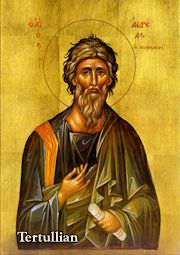
Tertullian
Tertullian

“To begin with the real ground of the military crown, I think we must first inquire whether warfare is proper at all for Christians. What sense is there in discussing the merely accidental, when that on which it rests is to be condemned? Do we believe it lawful for a human oath to be superadded to one divine, for a man to come under promise to another master after Christ, and to abjure father, mother, and all nearest kinsfolk, whom even the law has commanded us to honour and love next to God Himself, to whom the gospel, too, holding them only of less account than Christ, has in like manner rendered honour? Shall it be held lawful to make an occupation of the sword, when the Lord proclaims that he who uses the sword shall perish by the sword? And shall the son of peace take part in the battle when it does not become him even to sue at law? And shall he apply the chain, and the prison, and the torture, and the punishment, who is not the avenger even of his own wrongs? Shall he, forsooth, either keep watch-service for others more than for Christ, or shall he do it on the Lord’s day, when he does not even do it for Christ Himself? And shall he keep guard before the temples which he has renounced? And shall he take a meal where the apostle has forbidden him? And shall he diligently protect by night those whom in the day-time he has put to flight by his exorcisms, leaning and resting on the spear the while with which Christ’s side was pierced? Shall he carry a flag, too, hostile to Christ?…Is the laurel of the triumph made of leaves, or of corpses? Is it adorned with ribbons, or with tombs? Is it bedewed with ointments, or with the tears of wives and mothers? It may be of some Christians too; for Christ is also among the barbarians.”


Tertullian is arguing in support of a Christian soldier who refused to put on the laurel crown given to his company after a military victory. Wearing the laurel crown had some connotations of devotion to the civic deities of the Empire and was against the practice of the North African Christian community. The crown itself, however, is not the major issue in Tertullian’s mind as he is writing. He is more concerned with the unity of the church’s witness to the surrounding culture than with buttressing any legalism. At least some of the Christians of Carthage were beginning to question whether it was really a grave matter to participate in some aspects of Roman civic religion. Tertullian’s answer refuses to honor the legitimacy of the question about precisely where to draw the line of idolatry. Not only does he question the crown, he questions the actions that lead to being rewarded and recognized as a servant of the Empire.  In this context, he offers a powerful argument against Christian participation in the military—Christ is also among the barbarians!

As much as Tertullian wants to distinguish “Athens” and “Jerusalem,” it isn’t because he’s consigned Athens to eternal destruction. As he writes in polished Latin, drawing on the best of the philosophical and rhetorical traditions of his day, Tertullian is concerned that Christ should be honored everywhere that he may be found—and not at the point of the world’s sword.

___________________________

Excerpted from De Corona, chapters 11 and 12.

apologies

The silence in this region of the ether lasted longer than I intended. The trip to California was wonderful for a whole host of reasons. Someone I know sums it up pretty well, “Good things happen when people in mountains meet, this is not done by jostling on the street.”

In addition, I’ve now begun the program at Fordham and I’m now in the slow process of adjusting to a heavy load of course-work, an Albany-Bronx weekly commute, periodic separation from Carolyn, and the rhythms of life within a new community. All of this likely means that posts will continue slowly around here for a while. But don’t give up just yet…